Is Indonesia's Nickel Grip Fading?
How the world's dominant nickel producer is forcing its own investors to look elsewhere — and why the next chapter of the battery metals race will be written in Africa and the Pacific.
CRITICAL MINERALS
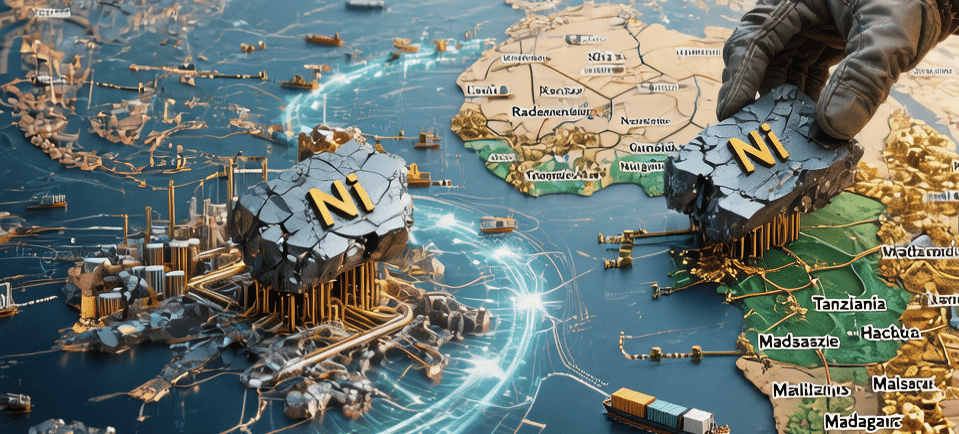
The architects of the world's nickel dominance are quietly drawing up Plan B — and Jakarta should be worried.
Five years ago, Indonesia executed the boldest resource play of the 21st century. By banning nickel ore exports in 2020, Jakarta forced the world's stainless steel and EV battery money to build smelters in situ— and it worked. Today, Indonesia accounts for more than 60% of global mined nickel output, up from roughly 30% in 2020. The archipelago became the undisputed command center of the battery metals age.
Chinese capital — led by Tsingshan Holding Group and HPAL pioneers like Lygend Resources (力勤资源) — poured well over $14 billion into mega-parks like Morowali (IMIP) and Weda Bay (IWIP). Low-cost, Chinese-built capacity flooded the market, crushed LME nickel prices, and forced Glencore, BHP, and Sumitomo to shutter or offload higher-cost operations.
But the builder is now squeezing its own guests. And the guests are looking at the exits.
The Squeeze: Jakarta's Triple-Pressure Campaign
Since Prabowo Subianto took office in late 2024, Indonesia's policy suite has shifted from downstream-or-bustto extract maximum rent:
RKAB quotas slashed: The 2026 nickel mining quota was cut to ~260–270 million wet tonnes from 379 million in 2025 — a >30% reduction. At Weda Bay, the world's largest single nickel operation (a Tsingshan–Eramet–Antam JV), the quota was hacked from 42 million to 12 million tonnes (−71%), forcing Eramet to halt production entirely in late May 2026 while it begs for an extension.
HPM benchmark repricing: The mineral price formula hiked the correction factor on 1.6% ore from 17% → 30%, and — for the first time — formally priced cobalt, iron, and chromium by-products into the ore cost. Translation: feedstock costs jumped overnight.
Royalties & state-control signals: Royalties on nickel already sit at 10%. Then came Prabowo's late-May proposal to run coal, CPO, and ferroalloy exports through a state-controlled export entity. NPI was said to be excluded — but the signaling alone spooked the room. The China Chamber of Commerce in Indonesia fired off a sharply worded warning letter to the president himself.
The numbers tell the story: FDI into Indonesia fell ~6% in 2025, snapping a 19% growth streak. New investment into base-metals refining has visibly plateaued.
The Pivot: Tsingshan → Madagascar. Lygend → Tanzania & New Caledonia.
This is where it gets consequential. The same firms that builtIndonesia's nickel hegemony are now scouting alternatives — and these would be their first nickel forays outside Indonesia, period:
Tsingshan
Move: Submitted a multi-billion-dollar proposal to Madagascar for a Morowali-style multi-mineral industrial park
Stage: Under review; no permits yet. Madagascar only lifted its 16-year mining-license freeze in Jan 2026 and sits under transitional military rule after a 2025 coup
Lygend Resources
Move: In talks to buy a stake in Tanzania's Kabanga — a ~2.6% nickel sulphide deposit (vs. Indonesia's ~1.5% laterite), needing ~$1B and ~6 years to reach ~50kt/yr
Stage: Advanced-stage talks with strategic investors; BHP already exited its 17% stake
Lygend / SMSP
Move: Made an offer to New Caledonia's state-owned SMSP for a stake in the idled Koniambo nickel smelter (once Glencore's, shut in 2024)
Stage: Under consideration
One Reuters source put it plainly: "These prospective investments would be each Chinese company's first nickel forays outside Indonesia."
Why This Matters — Nadibull's Read
The standard take is that Chinese firms are "escaping" Indonesian restrictions. That's incomplete. This is a strategic hedge against three structural risks:
Capital-cycle risk: You don't sink $3–5B into RKEF/HPAL parks on the assumption your ore quota can be chopped 70% by ministerial decree.
Geopolitical risk: US IRA rules, EU CBAM/carbon scrutiny, and "friend-shoring" mean a single-country-at-60%+ market share architecture is an uninsurable systemic concentration.
Grade reality: Indonesia's ore is laterite— bulky, energy-intensive, coal-hungry. Kabanga's 2.6% sulphide is the kind of grade that needs cleaner metallurgy and commands a different ESG profile.
Indonesia still owns the geology. That doesn't change tomorrow. What changes today is the psychology of capital. The moment the lead players visibly price alternatives, Jakarta's "resource nationalist" leverage has a ceiling — because everyone now knows the map extends beyond the archipelago.
Investor Bottom Line
Avoid overexposure to single-nation resource bets. Back operators are actively diversifying into emerging African markets and Pacific legacy assets with credible ESG frameworks. Global supply resilience — not cheap Indonesian ore — is the premium that's coming.
Supply chains don't snap; they fray. Madagascar and Kabanga are the fray lines. Watch them.
⚠️ Disclaimer: For informational awareness only. Nadibull Capital is not responsible for your next action. Do your own due diligence — especially where mining codes are being rewritten between coups.